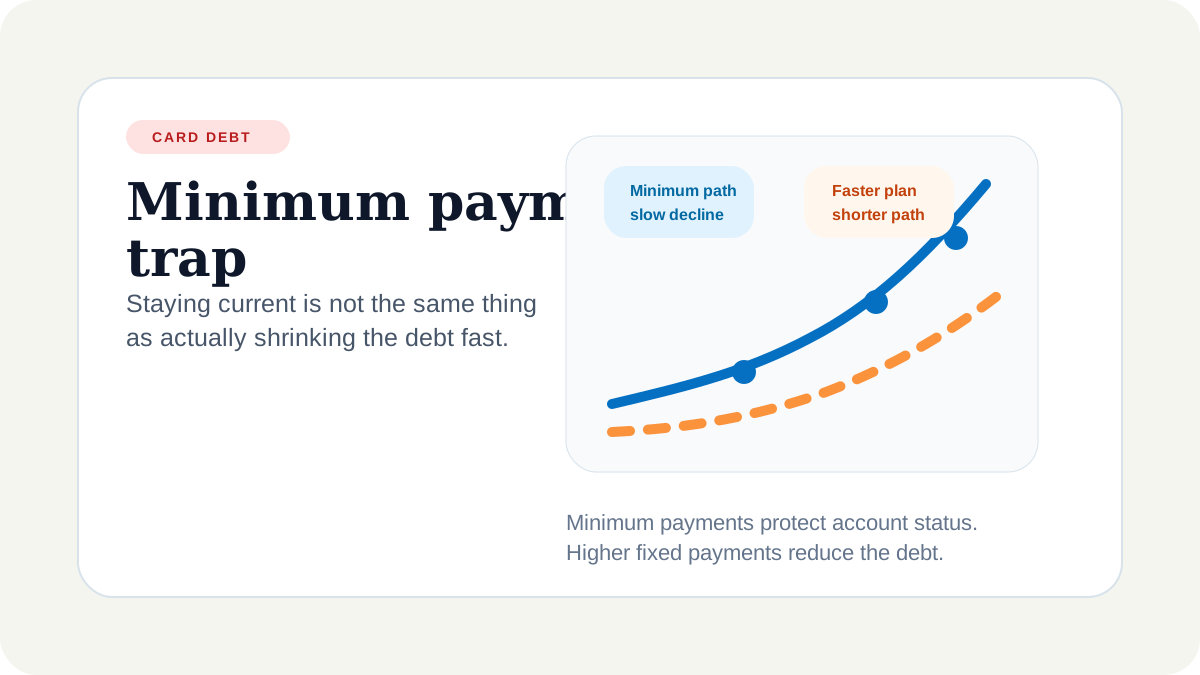
Minimum payments solve the immediate problem. They do almost nothing for the long-term debt problem. Their real job is to keep the account current while interest keeps building on the balance that remains.
What the minimum payment really is
The minimum is the smallest amount the card issuer accepts for that billing cycle. It protects the account status. It does not automatically protect your budget from long payoff horizons or large interest drag.
Why the balance falls so slowly
When the rate is high and the payment is barely above the monthly interest, a large share of your money goes to servicing the cost of the debt rather than clearing it. That is why many cardholders feel they are paying faithfully while the balance barely moves.
Credit cards
See how a modest payment increase changes the timeline
With card debt, even a relatively small monthly increase can shorten the payoff period dramatically and cut a surprising amount of interest.
When to move from minimum mode to reduction mode
If your budget has any stable surplus after essentials, card debt is often the first place where that surplus works hardest. Paying down expensive revolving debt is one of the few places where the benefit is clear, immediate, and mathematically predictable.
The most expensive illusion
Paying the minimum can feel responsible because the account remains in good standing. Financially, it often means the debt is still running the room.
How to connect payoff with the rest of your budget
The cleanest setup is usually simple: choose a fixed payment above minimum, stop adding fresh spending to the same card, and measure progress against a clear end date. Without that boundary, debt reduction can quietly turn into an endless loop.
The warning signs that the card is taking over
Credit cards
Set a realistic exit date for the balance
Instead of asking what the minimum is, ask what payment gets you out within 12, 18, or 24 months. That question usually leads to a much stronger plan.
The minimum keeps the card current, not the debt under control
Minimum payments solve the immediate compliance problem. They do not solve the debt problem. A real payoff plan needs a higher fixed payment and a defined finish line.
Common questions
Is it ever okay to pay only the minimum?
Yes as a short-term emergency move, but the longer it lasts, the more interest and time the balance absorbs.
Should I attack card debt before building more savings?
With a high card rate, faster payoff often gives a stronger guaranteed benefit than leaving the debt untouched.
What counts as a realistic monthly card payment?
A useful benchmark is any amount that gets the balance to zero in a defined period such as 12 to 24 months without breaking the rest of the budget.
Read next
APR vs interest rate: which number tells you the real loan cost?
A low interest rate can make an offer look cheap in the first line. APR usually gives you a better first read of the full borrowing cost.
How to calculate a loan payment without missing the real cost
A monthly payment is not just math on a formula sheet. Here is how to estimate the payment, compare repayment styles, and spot fees that quietly make the loan more expensive.
Compound interest explained without the marketing gloss
Compound interest matters, but the real result comes from time, regular contributions, tax, and inflation. Here is what actually moves the outcome.